EIS Pitch Deck
Updated
Quick answer
An EIS pitch deck for UK founders raising under the Enterprise Investment Scheme: up to £10m a year since April 2026, or £20m for knowledge-intensive companies. 14 slides leaning into growth-investment narrative, traction, and the risk-to-capital condition HMRC requires. Free PDF download, no signup.
Customise it, then press "Send as tracked link" in the editor: you get a link to send instead of an attachment, and see who opened it and which slide they stopped on. Or put it in a data room with an NDA gate. Free to start, no card.

What goes on each slide?
Slide structure
-
Slide 01
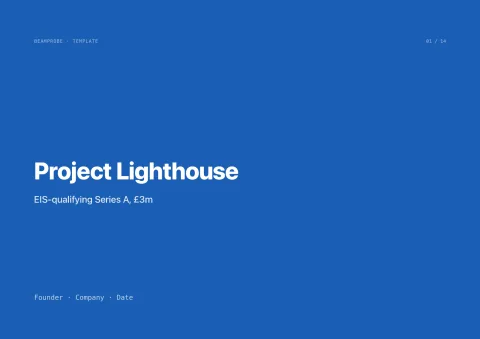
Project Lighthouse
EIS-qualifying Series A, £3m
Founder · Company · Date
-
Slide 02
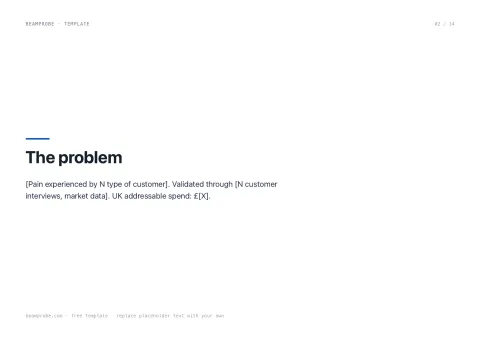
The problem
[Pain experienced by N type of customer]. Validated through [N customer interviews, market data]. UK addressable spend: £[X].
-
Slide 03
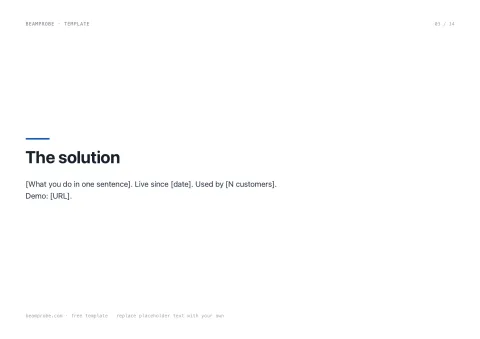
The solution
[What you do in one sentence]. Live since [date]. Used by [N customers]. Demo: [URL].
-
Slide 04
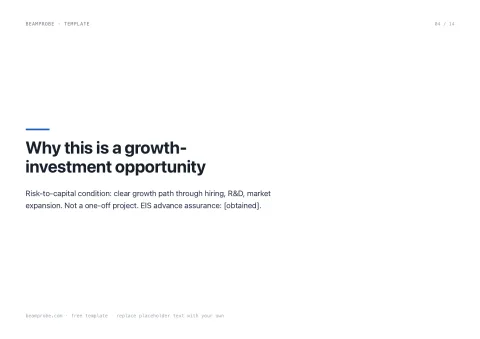
Why this is a growth-investment opportunity
Risk-to-capital condition: clear growth path through hiring, R&D, market expansion. Not a one-off project. EIS advance assurance: [obtained].
-
Slide 05
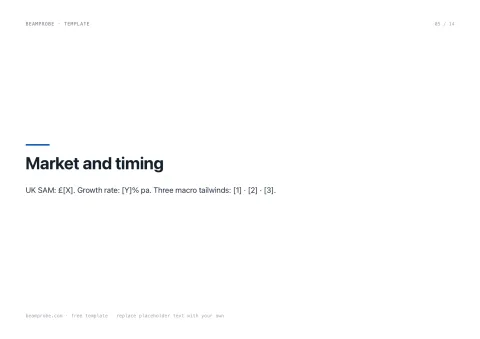
Market and timing
UK SAM: £[X]. Growth rate: [Y]% pa. Three macro tailwinds: [1] · [2] · [3].
-
Slide 06
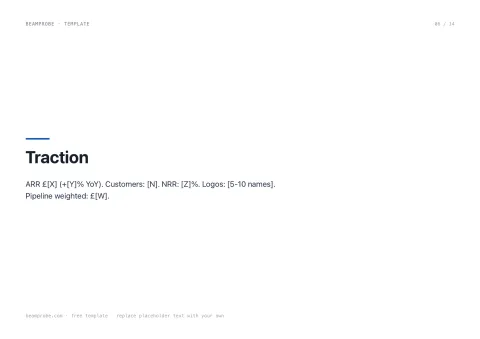
Traction
ARR £[X] (+[Y]% YoY). Customers: [N]. NRR: [Z]%. Logos: [5-10 names]. Pipeline weighted: £[W].
-
Slide 07
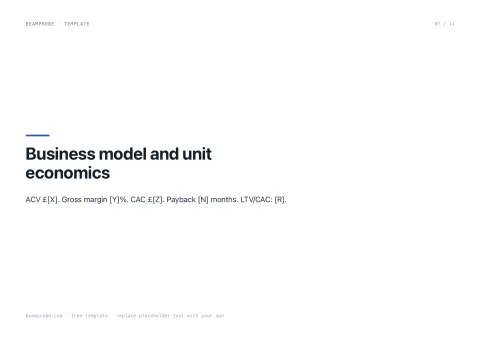
Business model and unit economics
ACV £[X]. Gross margin [Y]%. CAC £[Z]. Payback [N] months. LTV/CAC: [R].
-
Slide 08
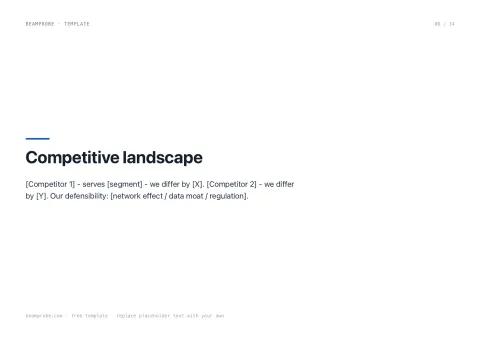
Competitive landscape
[Competitor 1] - serves [segment] - we differ by [X]. [Competitor 2] - we differ by [Y]. Our defensibility: [network effect / data moat / regulation].
-
Slide 09
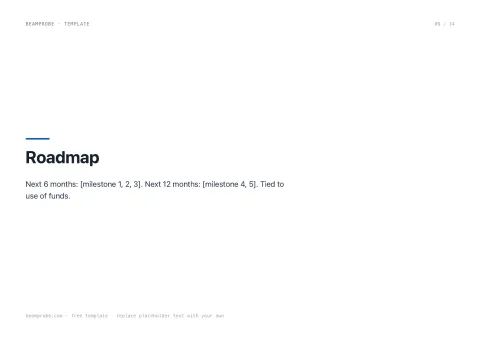
Roadmap
Next 6 months: [milestone 1, 2, 3]. Next 12 months: [milestone 4, 5]. Tied to use of funds.
-
Slide 10
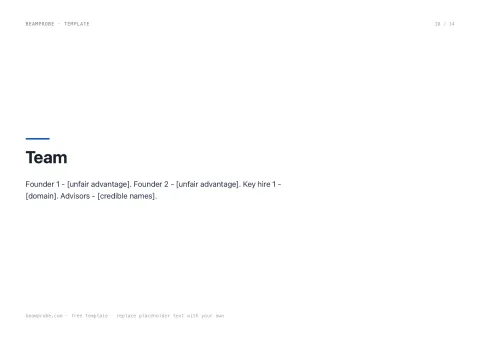
Team
Founder 1 - [unfair advantage]. Founder 2 - [unfair advantage]. Key hire 1 - [domain]. Advisors - [credible names].
-
Slide 11
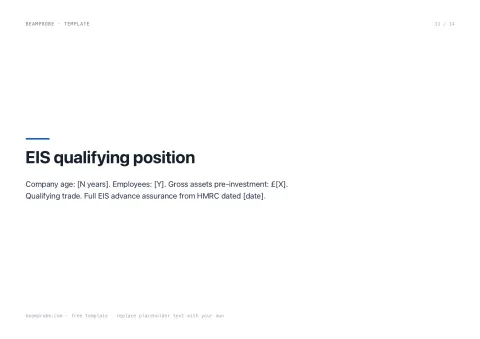
EIS qualifying position
Company age: [N years]. Employees: [Y]. Gross assets pre-investment: £[X]. Qualifying trade. Full EIS advance assurance from HMRC dated [date].
-
Slide 12
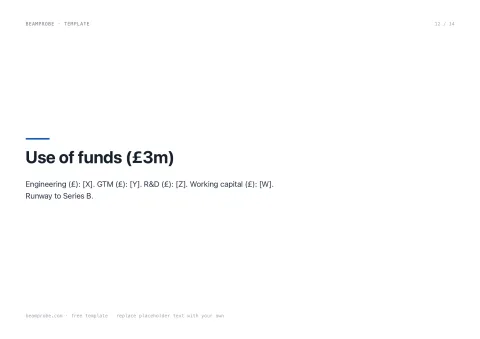
Use of funds (£3m)
Engineering (£): [X]. GTM (£): [Y]. R&D (£): [Z]. Working capital (£): [W]. Runway to Series B.
-
Slide 13
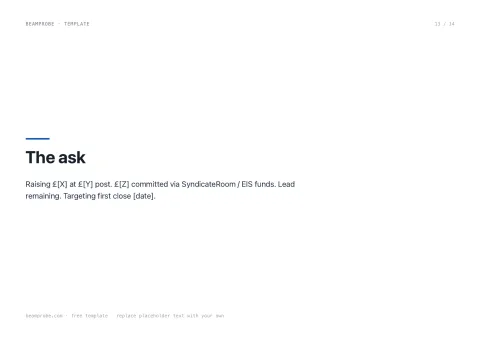
The ask
Raising £[X] at £[Y] post. £[Z] committed via SyndicateRoom / EIS funds. Lead remaining. Targeting first close [date].
-
Slide 14
Thank you
[Founder name] · [email] · [calendar link] · [data room link]
Investor context for EIS Pitch Deck.
What investors look for
- EIS advance assurance from HMRC dated recently
- Risk-to-capital condition satisfied through growth-investment story
- Genuine traction: ARR, customers, retention, not just signups
- Defensible unit economics: gross margin, CAC, LTV, payback
- Realistic post-money valuation justified by traction multiples
When to use this template
- £500k to £10m raise, often the round after SEIS
- UK company usually under 7 years from its first commercial sale, gross assets under £30m before the issue, under 250 employees
- Raising from EIS funds (Octopus, Praetura, SyndicateRoom, Triple Point) or EIS-eligible VCs
What NOT to include
- Anything that signals one-off project rather than a growing business
- Vague competitor matrix with all green ticks for you and red for them
- Salary projections for founders before product-market fit
- Cap-table dilution scenarios that pre-empt term-sheet negotiation
EIS Pitch Deck.
FAQ
What is an EIS pitch deck?
An EIS pitch deck is the slide structure UK companies use to raise under the Enterprise Investment Scheme, which since April 2026 covers up to £10m a year and £24m in total (£20m and £40m for knowledge-intensive companies). It frames the business so EIS investors and EIS funds (Octopus, Praetura, SyndicateRoom, Triple Point) can see the growth investment, qualifying trade, and risk-to-capital condition.
What is the risk-to-capital condition for EIS?
HMRC requires EIS-eligible companies to demonstrate genuine growth ambition (hires, R&D, market expansion) rather than a one-off project with predictable returns. The deck makes this explicit through the roadmap, use of funds, and milestone slides.
How does an EIS deck differ from an SEIS deck?
EIS rounds are larger (up to £10m a year vs £250k under SEIS), companies are more mature (usually up to 7 years from the first commercial sale vs 3 years, and up to £30m gross assets before the issue vs £350k), and the deck leans into traction, unit economics, and growth-investment framing. SEIS leans into vision and team.
Do EIS investors expect an NDA on the deck?
No. UK EIS investors and funds receive hundreds of decks per quarter and refuse to sign NDAs at deck stage. NDAs come at the data room stage post-term-sheet.
How do I send this EIS deck to investors?
Use a tracked link tool like Beamprobe so you can see which fund engaged with which slide. Free plan, or £29 a month flat for Pro with a 7-day free trial.
Keep going.
Related reading
How do you share your finished deck securely?
Send your finished deck through a per-recipient tracked link. See which slides each investor read, for how long, and on which day. NDA gate, watermark, expiry - all on the £29 Pro plan. Documents stored in London by default.