Healthtech Pitch Deck
Updated
Quick answer
A free healthtech pitch deck template for digital health, medtech and biotech founders raising in the UK. 14 slides covering clinical evidence and your NICE evidence tier, the regulatory route (MHRA, UKCA, DTAC for the NHS), who pays and from which budget, and the team's clinical credibility. Free PDF download, no signup.
Customise it, then press "Send as tracked link" in the editor: you get a link to send instead of an attachment, and see who opened it and which slide they stopped on. Or put it in a data room with an NDA gate. Free to start, no card.

What goes on each slide?
Slide structure
-
Slide 01
Company name
Digital health for [condition / care pathway]
Raising £[X] · [Date]
-
Slide 02
The clinical problem
Specific patient population. Burden of disease. Current standard of care and where it fails.
-
Slide 03
The solution
What the product does. Clinical mechanism. Decision-support, monitoring, diagnostic, therapeutic.
-
Slide 04
Clinical evidence
Peer-reviewed studies, trials, real-world evidence. Cite. Effect size with confidence interval. NICE evidence tier.

-
Slide 05
Regulatory pathway
MHRA, UKCA or CE marking; FDA for the US. Class I / IIa / IIb / III or software as a medical device. DTAC and DCB0129 for the NHS. Status and timeline.
-
Slide 06
Who pays
NHS trust or ICB budget, private insurer, employer, patient. NHS Payment Scheme and HRG codes where they apply; CPT codes for the US.
-
Slide 07
Market
Patient population x annual cost. Care-setting (hospital, primary care, home). Health economic case.
-
Slide 08
Traction
Pilot sites, patients enrolled, clinical outcomes, NHS contracts.
-
Slide 09
Business model
Per-patient-per-month, per-site licence, value-based contract. Gross margin, COGS.
-
Slide 10
Team
Founders, clinical advisors, regulatory advisors. Medical or scientific credibility.

-
Slide 11
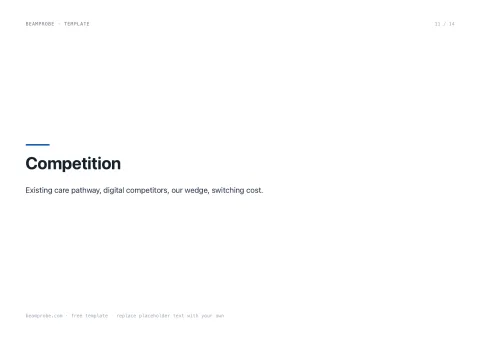
Competition
Existing care pathway, digital competitors, our wedge, switching cost.
-
Slide 12
Roadmap
Pipeline indications, additional clinical studies, geographic expansion.

-
Slide 13
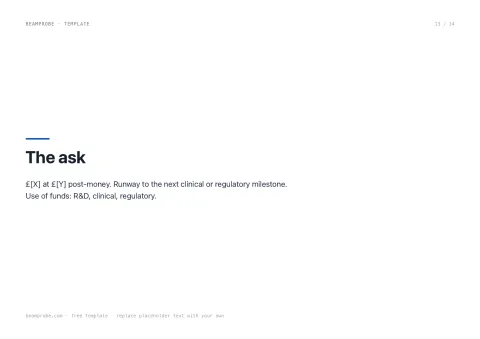
The ask
£[X] at £[Y] post-money. Runway to the next clinical or regulatory milestone. Use of funds: R&D, clinical, regulatory.
-
Slide 14
Thank you
Contact and data room.

Investor context for Healthtech Pitch Deck.
What investors look for
- Clinical evidence with effect size, confidence interval, and citation
- Clear regulatory pathway: MHRA and UKCA (FDA for the US) with device class, plus DTAC for NHS buyers
- Who pays: NHS trust or ICB budget, private insurer, employer or patient
- Clinical advisor or co-founder with deep domain credibility
- Health economic case showing cost saving or improved outcome
When to use this template
- Digital health, biotech, or medtech company raising seed or Series A
- Pitching to healthtech-focused VCs (Octopus Ventures HealthTech, Heal Capital, Adjuvant, Optum Ventures)
- Any raise where the team must justify clinical credibility to a non-clinical investor
What NOT to include
- Software-only team slide for a regulated medical device company
- Vague reimbursement language; investors need specifics
- Generic patient testimonials in place of peer-reviewed evidence
- Bypassing regulatory pathway with 'we are an information service' if you are not
Healthtech Pitch Deck.
FAQ
What is a healthtech pitch deck?
A healthtech pitch deck is the slide structure digital-health, biotech, and medtech founders use to raise from health-focused investors. It differs from a generic SaaS deck by including clinical evidence, regulatory pathway, reimbursement model, and clinical advisor credibility.
What clinical evidence do healthtech investors expect?
Peer-reviewed studies with effect size and confidence interval, real-world evidence, or pilot outcomes from named NHS trusts or health systems. Even pre-product, investors expect a credible plan to generate evidence (a registered trial, a pilot site, a published protocol). For digital products, say which tier of NICE's Evidence Standards Framework you sit in, because it sets the evidence the NHS will expect.
What regulatory pathway should the deck address?
In Great Britain, medical devices are regulated by the MHRA and carry a UKCA mark, with CE-marked devices still accepted for a transition period; selling in the US needs the FDA. State the device class (I, IIa, IIb or III, including software as a medical device) and the current status. If you are pre-approval, give the route, a timeline and the budget.
What does the NHS ask for before buying a digital health product?
Most NHS organisations ask for the Digital Technology Assessment Criteria (DTAC), which cover clinical safety, data protection, technical security, interoperability and usability, and for a clinical safety case under DCB0129 from the manufacturer. Showing you have these, or a date for them, answers the investor's question about how long NHS sales will take.
What reimbursement model should the deck show?
Who pays and from which budget: an NHS trust or integrated care board, a private insurer, an employer or the patient. Hospital activity in England is paid through the NHS Payment Scheme, which replaced the national tariff in 2023, using HRG codes, but most digital products are bought from a trust or ICB budget, so the health economic case matters more than a code. Use CPT codes only if you sell in the US.
How do healthtech investors evaluate the team slide?
They look for a clinician co-founder (or medical advisory board), regulatory experience, and prior healthtech exits. A pure-software team without clinical credibility is harder to fund at the same stage.
Keep going.
Related reading
How do you share your finished deck securely?
Send your finished deck through a per-recipient tracked link. See which slides each investor read, for how long, and on which day. NDA gate, watermark, expiry - all on the £29 Pro plan. Documents stored in London by default.